Wondering how many Playpen Balls you need to fill a ballpit? Curious how many Croffles to cover your electroplating tank? Or perhaps you’re calculating how many Shade Balls your reservoir requires? Our powerful Euro-matic Ball Calculator does all the hard maths for you—quickly, accurately, and effortlessly.
| Product | Product | |
| Area shape | Area shape | |
| Length of one side | Length of one side | m |
| Depth of balls | Depth of balls | m |
| Calculate Reset | ||

What is Circle Packing?
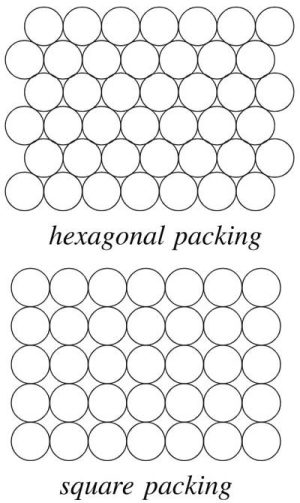
Circle packing refers to the arrangement of non-overlapping circles on a flat surface. This concept applies to various real-world scenarios, such as covering tanks, reservoirs, or swimming pools with balls. Importantly, the key metric to consider is packing density, which represents the percentage of surface area covered by the balls.
Hexagonal Packing – The Most Efficient Layout
In 1773, mathematician Joseph Louis Lagrange demonstrated that the hexagonal lattice (a honeycomb-like pattern) is, in fact, the most efficient way to pack circles in two dimensions. Specifically, in this pattern, each circle touches six others, leading to a maximum packing density of:
Density = (π√3)/6 ≈ 90.7%
To calculate how many balls are needed to cover a surface, follow these steps:
Determine the area of the surface.
Divide it by the area of a single ball (in 2D).
Multiply by the packing efficiency (90.7%).
Note: It’s important to note that this calculation assumes ideal packing and does not account for partial balls at edges or minor gaps. However, the errors are typically less than 1% when dealing with large areas.
What is Sphere Packing?
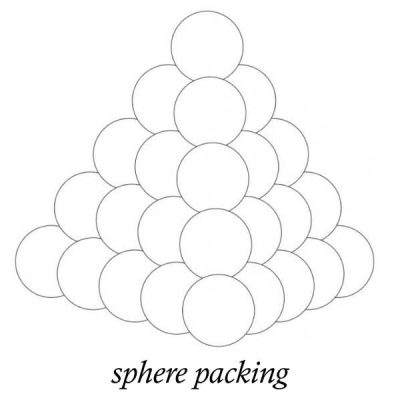
Sphere packing, on the other hand, calculates how many balls (spheres) are required to fill a 3D space, such as a ball pit, tank, or container. There are several packing methods to consider, including cubic, face-centered cubic, and hexagonal close packing.
Most Efficient 3D Packing
In 1831, Carl Friedrich Gauss proved that hexagonal close packing achieves the highest theoretical density:
Density = π/(3√2) ≈ 74.0%
In real-world applications:
Theoretical maximum packing density: 74%
Typical random packing (e.g. playpen balls): ~64%
Minimum effective density: ~60%
To calculate ball requirements:
Determine the total volume to be filled.
Calculate the volume of a single ball.
Apply a packing efficiency of ~64% for randomly poured balls.
According to ROSPA (Royal Society for the Prevention of Accidents)
there are several important safety guidelines to follow:
Summary: Accurate Ball Coverage and Volume Estimates
Use these principles of 2D and 3D ball packing to get precise estimates for:
Covering flat surfaces with balls
Filling volumes like ball pits or tanks
Ensuring safe and efficient use of ball products
Try our Euro-Matic Ball Calculator for fast, accurate calculations based on these proven packing formulas.